



Norway Working Holiday Visa - Our Complete Guide For 2027
by Jessie Chambers a year ago
9 MIN READ
(This guide has been updated for accuracy on 24th of September 2026)
ILet's deal with the obvious thing first. Norway is expensive. A beer will cost you what a round costs elsewhere, and the first time you buy groceries you will stand in the aisle doing currency conversion and quietly reconsidering your life. So, getting there and making the math actually make sense, earning a little cash money while you experience one of the most underrated countries in Europe - like yeah, it’s the way to do it!
Working in Norway looks a little like: working four days and having a fjord to yourself on the fifth. You'll finish a shift in June and walk home at midnight in full daylight because the sun has simply declined to set. In February you'll see the sky turn green above your own street and understand why people move here and don't leave.
The maths is not what the internet tells you it is.
A working holiday buys you up to a year of it, and for two nationalities on this list, up to two.
What This Visa Actually Is
Norway doesn't issue a working holiday visa in the strict sense. It grants a residence permit for a working holiday, which sits inside its exchange and cultural work category and is available only to citizens of six countries with bilateral arrangements in place. Slim pickings - but if you’re one of the lucky ones, buckle up baby!
The purpose is a longer holiday during which you also work, rather than a job you happen to holiday around. That distinction shapes the rules: caps on how long one employer can keep you, limits on study, and no route for family to follow you over.
Norway Working Holiday Visa at a Glance
- Who: citizens of Andorra, Argentina, Australia, Canada, Japan and New Zealand
- Age: over 18 and not yet turned 31 when you apply. Canadians get until they turn 36
- Duration: up to one year, with Australians and Canadians able to reach two years in total
- Fee: NOK 6,300, the standard residence permit for work rate
- Funds: NOK 15,488 per month, meaning NOK 46,464 for your first three months
- A job offer is not required: funds can be savings, a confirmed offer of paid work, or a mix of both
- Employer cap: no more than six months with the same employer
- Insurance: medical and full hospital cover, arranged before you enter Norway
- Apply: online through the Norwegian Directorate of Immigration, then attend in person for biometrics
Who Qualifies, and What You'll Need
Six countries hold arrangements with Norway, and the shape of the permit shifts depending on which passport you carry.
What applies to nearly everyone:
- Age: over 18 and not yet 31 at the time of application. Canada is the exception at under 36
- Citizenship, not residency: you must actually be a citizen of the qualifying country, and for several nationalities you must be residing there when you apply. Permanent residence isn't enough
- Money for the first three months: NOK 15,488 a month, NOK 46,464 across three. This can be cash in the bank, a concrete offer of paid work, or a combination
- Insurance: most nationalities sign a declaration that they'll take out medical insurance and full hospital insurance before entering. Japanese applicants must already hold cover valid for the whole stay
- Health: Australian and Japanese applicants must be in good health, meaning it shouldn't be likely you'll need hospital treatment during the stay
- Study limit: you can't use this permit if you intend to study for more than three months. That needs a study permit instead
- Employer cap: six months maximum with any single employer
- No family route: your partner and children cannot apply for family immigration to join you
Where your passport changes the deal:
- Australians: under 31 at application. Granted one year at a time up to a two-year total, and you're allowed to be over 31 when you apply to renew
- Canadians: under 36, the most generous age range here, and the structure is different. Your stay must fall into one of five categories: work experience after higher education, studies through an exchange agreement, temporary secondment, holiday work while enrolled at a Canadian university, or tourist. The six-month employer cap applies to the tourist category. You can reach two years in total, and you can apply again later under a different category
- New Zealanders and Japanese citizens: under 31, one year in total, no renewal beyond it
- Argentinians: under 31, one year in total, and there's a cap of 300 permits a year. The 2026 allocation has already been reached, with applications reopening at the beginning of January 2027. Applications go through an embassy or application centre in Argentina
- Andorrans: under 31, one year in total, and your passport must stay valid for the entire permit period
No arrangement exists for British, Irish, American or European Union passport holders, so this route isn't available - soz.
How to Apply
- Check your category on the immigration portal. The requirements genuinely differ by nationality, and Canadians in particular need to work out which of the five categories they're applying under before starting.
- Sort your money first. You're documenting NOK 46,464 for the first three months. If part of that is a job offer rather than savings, get the offer in writing before you apply.
- Submit the application online. You register and pay through the Directorate of Immigration's own portal.
- Pay the fee. NOK 6,300, and it isn't refunded if the application is refused.
- Book your appointment. You attend an embassy, consulate or application centre in person to hand over documents and give fingerprints and a photo. This is a document appointment, not an interview.
- Wait, and stay put. This is the part people get wrong: you cannot enter Norway until a decision has been made, and you cannot start working until the permit has actually been granted.
- Report to the police after you arrive. Once you land you attend your local police district so your residence card can be issued.
Processing times move around depending on category and volume, and the immigration service publishes current waiting times rather than a fixed figure. Don't book a non-refundable flight against an estimate. Put your risk mitigation hat on and make sure you give yourself some of that flex.

Work Life
Work is allowed and expected, with the six-month cap per employer shaping how the year tends to run. English gets you further here than in most of Europe, because Norwegian workplaces are used to it.
- Tourism: the summer fjord season and the winter northern lights season both hire heavily, from guiding to hotel and hospitality roles, sometimes with accommodation attached.
- Hospitality and retail: the cities absorb seasonal staff year-round, and English is workable in most customer-facing roles.
- Fisheries and seafood processing: coastal Norway runs on it, the work is physically hard, and it's one of the more reliable routes for someone arriving without Norwegian.
- Agriculture: the summer berry and crop harvest takes on short-term workers without a language requirement.
- Ski season: the winter resorts staff up from December, and the pattern of six months on, then move, fits the employer cap neatly.
Two practical things. Get your Norwegian identification number sorted at the tax office early, because it unlocks banking and almost everything else. And reformat your CV to the Norwegian standard rather than sending the one you use at home. Boring adult things, but a must and ensures smooth sailing from there on out!
The Reality and Your First Weeks
Norway will out-price your expectations. Oslo rents are steep, eating out is a genuine event rather than a default, and the alcohol pricing is a policy position rather than an accident. Most people share flats, cook at home and treat the NOK 46,464 as a floor rather than a target.
The other thing to plan for is the dark. Above the Arctic Circle the sun doesn't clear the horizon for weeks in midwinter, and even Oslo gets barely six hours of light in December. Some people find it cosy. Others find it much harder than they expected, and it's worth knowing which you are before you commit to a February start date.
Practically, your first fortnight is the tax office for your identification number, the police for your residence card, a bank account once the number comes through, and a transport pass. None of it is difficult. All of it has queues.
You can arrange this whole thing yourself and most people on this permit do. It works. It just front-loads the admin.
Where to Actually Go: Your Norway Hit List
Oslo
The centre is fine and you'll barely go there. Grünerløkka is the one, running along the Akerselva river, full of second-hand shops, cafes and the kind of bars people stay in until closing. Grønland next door is the cheapest and best place to eat in the city. Vulkan is the reclaimed industrial pocket where the food hall lives.
- Coffee, taken very seriously: Tim Wendelboe in Grünerløkka is a pilgrimage site for anyone who cares about roasting, Supreme Roastworks is the one locals actually use daily, and Fuglen does coffee in the day and cocktails at night out of the same mid-century room
- Nights out: Blå sits on the river and books jazz, hip hop and club nights in equal measure, Jaeger handles the techno end, and Torggata is the street to walk if you want to decide as you go
- Eating: Mathallen in Vulkan for a food hall you'll lose an afternoon in, Grønland for the best value meal in Oslo by a distance
- The move nobody expects: Salt on the waterfront, a cluster of wooden structures with saunas, a bar and live music, where you sweat and then get into the fjord. Sørenga's harbour pool does the swimming version in summer
Bergen
Rainier than Oslo by a wide margin and worth it anyway. Bryggen, the old wooden wharf, is the postcard, and Nordnes out on the peninsula is where you'd actually want to live, with sea baths at the end of it. The Fløibanen funicular hauls you up Fløyen in eight minutes for a view over the whole harbour, and it runs late.
Kvarteret, the student house, is the reliable answer for cheap nights and live music, and Landmark at the art gallery does the café-by-day, bar-and-DJs-by-night trick well. Bergen is a student city with a fishing town's attitude, and the combination works.
Tromsø
Nearly 350km above the Arctic Circle, which means polar night in winter and a sun that never sets in summer. This is the city for aurora season, and the trade-off is that in December you're living in blue twilight. Ølhallen, the old Mack brewery hall, is the pub with the deepest roots in town. Go up the Fjellheisen cable car after dark and look back at the lights.
We will hear nothing against Tromsø in January. It's genuinely one of the strangest and best places to be alive.
Lofoten
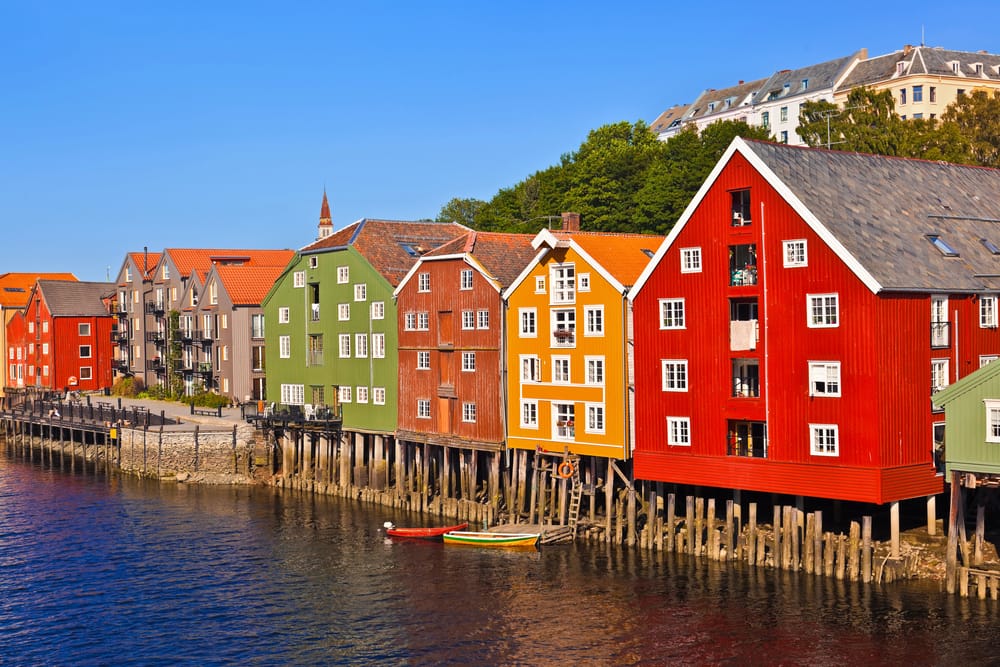
Not a city, a weekend. Fishing villages painted red against black mountains that come straight out of the sea, hiking that doesn't feel real, and cabins on stilts over the water. Go in summer for the midnight sun, go in winter for the aurora over the peaks, go once at minimum.
Where to Go When You Get a Week Off
Around late January, roughly everyone on this permit develops the same craving: sunlight, and a lot of it. Norway's airports connect south cheaply, and a week somewhere the sun clears the rooftops does more for you than you'd think.
- Gelato in Florence: one to two weeks learning to make it properly, which is a ridiculous and excellent way to spend a winter break
- Painting & Drawing in Florence: from two weeks, and if a Norwegian winter has you indoors anyway, you may as well come out of it able to draw
- Ultimate Sailing Skills in Primosten: two weeks on the Croatian coast, for the summer version of the same instinct
Before You Book Anything
We don’t run specific trips to Norway, so this one you'll assemble yourself. The application is manageable, and if you follow outline above you will be all gravy. But, a bit of advice, give yourself plenty of time to
Insurance is the piece worth doing properly, since you're committing to medical and full hospital cover before you enter and Norwegian healthcare costs are what you'd expect. Global Travel Cover fits: $0 deductible, buy and renew from anywhere, snow sports covered as standard, which is not a small detail in this particular country, and a 24/7 emergency line.
If you'd rather land somewhere with job matching, housing and arrival support already in motion, Global Work & Travel runs working holidays in a range of destinations.

Final Thoughts
Here is what people who've done a year in Norway say afterwards, almost without exception: the money worked out, and they stopped noticing the prices around month three.
What they talk about instead is the light. The way summer stops having a night in it and you end up swimming at eleven in the evening because why not. The way winter compresses everything into a few blue hours and makes staying in feel like a decision rather than a defeat. The way the aurora, the first time, is nothing like the photographs.
You'll come home with better waterproofs and a slightly annoying habit of mentioning fjords. Worth it.
Present you is the one who has to fill in the form. Future you gets everything else.
We also publish extensive working holiday visa guides for United States, Canada, Australia, United Kingdom, Germany, France, Spain, Italy, Ireland, Norway, Korea, Argentina, Chile, Hong Kong, Estonia, Netherlands, Austria, Slovakia, Portugal, Peru, Greece, Singapore, Malaysia, Taiwan, Mongolia, Indonesia, Vietnam, Thailand, New Zealand, Chile, Ecuador, Brazil, Israel, Czech
Republic, Mongolia, Papua New Guinea, and more coming.

Jessie Chambers
Jessie is a globetrotter and storyteller behind the Global Work & Travel blog, sharing tips, tales, and insights from cities to remote escapes, informed by the collective experience and real-world knowledge of teams across our business.