



Mongolia Working Holiday Visa - A Complete Guide For 2026
by Jessie Chambers a year ago
9 MIN READ
Some places you visit. Mongolia you enter. One minute you're in Ulaanbaatar dodging traffic and ordering a flat white that would hold its own in Melbourne, the next you're four hours out of the city watching a herder move a thousand sheep across a plain so wide it makes the horizon look up for debate. The colour of the sky is really that blue. Everything does feel like it’s in max HD and you’ll 100% get the most reactions with, “oh wow, how was it?”.
This is the one nobody in your friend group has done. While everyone else is doing laps of the same three European capitals, you'd be sleeping in a ger under more stars than you knew existed, learning to ride a horse like you actually mean it, and building a year no algorithm served you. Consider this your sign. The steppe is not going to come to you.
What This Visa Actually Is (and Who Can Get It)
A working holiday visa is a government arrangement that lets young people live in another country for up to a year and pick up short-term work to help fund the trip. Mongolia runs one, but here is the part most guides skate straight past: right now, the arrangement is open to Australians only.
Australia and Mongolia signed a reciprocal Work and Holiday deal back in 2022, and it is the single confirmed pathway on the board. Up to 100 Australians a year, twelve months in the country, work permitted along the way.
If you hold a passport from somewhere other than Australia, your move is to check directly with your nearest Mongolian consulate, because bilateral arrangements shift and new ones open. If you are Australian, keep reading, because this one is genuinely yours.
Mongolia Work and Holiday Visa: Quick Summary
- Who: Australian citizens aged 18 to 30 (you must apply before you turn 31)
- How long: 12 months, multiple entry
- How many: up to 100 Australians per year
- Education: hold a tertiary qualification, or have completed at least two years of undergraduate study
- Funds: enough savings to support yourself, plus an onward ticket or the funds to buy one
- Insurance: comprehensive health cover for your whole stay is strongly recommended and essential for the year ahead
- Consent letter: a letter from the relevant Australian government ministry confirming the government supports your stay under the agreement
- Apply: online through Mongolia's official e-visa portal, then register in-country within seven days of landing
Why Mongolia Hits Completely Different
Let's be honest about the pull here. Mongolia is one of the last genuinely reachable places on earth that the internet hasn't flattened into a queue and a photo spot. You will not be lining up behind two hundred people for the same shot. Half the time there is no line because there is no one else. The way we would trade three influencer brunches for one night in a herder's ger, no notes.
And the scale rewires you. Australia taught you what empty looks like, and then Mongolia goes: cute, hold my airag. It is the most sparsely populated sovereign country on the planet, which means you get space in a quantity that feels almost rude. Ulaanbaatar has the coffee, the clubs, the co-working, the whole modern city thing sorted. Then you drive twenty minutes and it is you, your horse, and roughly nine hundred years of nomadic tradition carrying on exactly as it always has. Two Mongolias, one visa, and you get both.
Then there is the welcome, which nobody warns you about. Mongolian hospitality is a national reflex, and a stranger waving you into their ger for salty milk tea is not a tourist experience laid on for you, it is just how the day goes out here. You will leave with a phone full of landscapes and a head full of the people who made you feel at home in the middle of nowhere. That is the part that stays.
The Visa at a Glance
Here is the detail behind the summary, verified against the Mongolian Embassy in Canberra and the Australian government's own announcement of the arrangement:
- Age: you must be at least 18 and not yet 31 at the time you apply, so 18 to 30 inclusive
- Nationality: Australian citizens only under the current reciprocal arrangement
- Duration: twelve months from entry, multiple entry so you can cross in and out
- Education requirement: tertiary qualifications, or successful completion of at least two years of undergraduate university study
- Funds: proof of sufficient savings to support yourself, shown through bank statements
- Onward travel: a ticket out of Mongolia, or enough money to buy one
- Health and character: you must meet Mongolia's health and character requirements
- No dependants: you cannot be accompanied by dependent children
- One-time only: you cannot have previously taken part in Mongolia's Work and Holiday arrangement
- Government consent letter: you need a letter from the relevant Australian government ministry stating that the Australian Government consents to your stay under the terms of the agreement
That last one is the requirement people miss, and it is not one you want to discover late. Build it into your timeline from day one.
How to Apply
The process is manageable, but the details are where applications live or die. Work through it in order.
- Confirm you tick every box. Australian passport, aged 18 to 30, the education requirement met, no prior participation. If any of these is a no, stop here and save yourself the fee.
- Gather your documents. Valid passport with at least six months of validity, passport photos, bank statements showing sufficient funds, proof of onward travel or funds for it, comprehensive health insurance, and your government consent letter.
- Sort the consent letter early. This comes from the Australian side and takes time. Chase it first, not last.
- Apply through Mongolia's official e-visa portal. Submit the application and pay the fee, which is non-refundable, so double-check everything before you hit send.
- Wait, then travel. Processing usually takes a few weeks. Apply at least three months before you want to fly, even when the stated window looks shorter, because buffer time is the difference between calm and chaos.
- Register on arrival. Because you are staying longer than thirty days, you must register with the Immigration Agency of Mongolia within seven days of landing. Bring your passport, visa documents, and your accommodation details.
You can absolutely organise all of this yourself, and plenty of independent travellers do. It works. It is also more paperwork, more chasing, and more solo problem-solving than the countries with a slick online-only system, so give yourself runway.
Work Life in Mongolia
Worth setting expectations here: this is a holiday-first visa, and the work is short-term to help fund the adventure rather than a full career year. Within that, there are real options, and most of them cluster in Ulaanbaatar.
- Teaching English: the most accessible route. Language schools, private centres, and conversation classes are always after native English speakers, and formal teaching qualifications are not always required for casual or activity-based classes.
- Tourism and hospitality: this comes alive from May to September. Tour companies want guides with strong English, and hotels, restaurants, and the ger camps need service staff over the busy summer.
- Remote and freelance work: Ulaanbaatar's connectivity is solid, so if your income already travels with you, you can base yourself in the city and explore around your own schedule.
- NGO and non-profit roles: international organisations run community, conservation, and education work. These tend to pay modest allowances rather than salaries, so go in for the experience, not the payday.
Top Tip: bring a bilingual resume, English on one side, Mongolian on the other. It is a small effort that opens doors and reads as respect, which locals genuinely notice.
The Reality Check
Mongolia is a remarkable year, and it is also not the easiest working holiday to pull off, so go in clear-eyed. The 100-place annual cap means this is competitive, and it is not guaranteed, so apply early and have your documents immaculate. Outside Ulaanbaatar, roads, accommodation, and mobile coverage thin out fast, and getting around often means shared vans on loose timetables or domestic flights that cost more than you expect. Winter is not a minor detail either, with temperatures that regularly drop far below anything an Australian summer prepares you for.
Budget more than the daily cost of living suggests, too, because the real spend in Mongolia is movement: domestic flights, chartered vehicles, and guided trips into the regions you cannot safely reach on your own. On money, your tax position depends on how long you stay: non-residents are generally taxed at a flat rate on Mongolian-sourced income, while longer stays that make you a tax resident are treated differently, so confirm your situation with the local tax office or employer rather than assuming a single figure. None of this is a reason not to go. It is a reason to plan properly before you do.
Places You Need to See
Ulaanbaatar is your landing pad and your soft entry into all of it. Soviet-era blocks sit next to glass towers, monasteries hum a street away from cocktail bars, and Gandantegchinlen Monastery and the National Museum give you the whole old-meets-new story in an afternoon. Give it a few days before you bolt for the wild. You'll want the context.
The Gobi Desert is the one that ruins other deserts for you. The Flaming Cliffs glow properly orange at sunset, the Khongoryn Els dunes actually sing when the sand shifts, and this is dinosaur-fossil country, the real kind, not the gift-shop kind. Ride out on horseback or camel and let the silence do its thing.
Khövsgöl Lake is Mongolia showing off. One of the largest freshwater lakes in the country, ringed by forest and mountains, unreal in summer and frozen solid enough to drive across in deep winter. Bring the camera and lower your expectations for getting any actual rest, because you will not stop looking at it.
Kharkhorin was once Karakorum, capital of the Mongol Empire, and standing there hits differently when you remember what was run from this spot. The Erdene Zuu Monastery and its 108 stupas is the anchor. History nerds, this is your Roman Colosseum moment, just with fewer crowds and more sky.
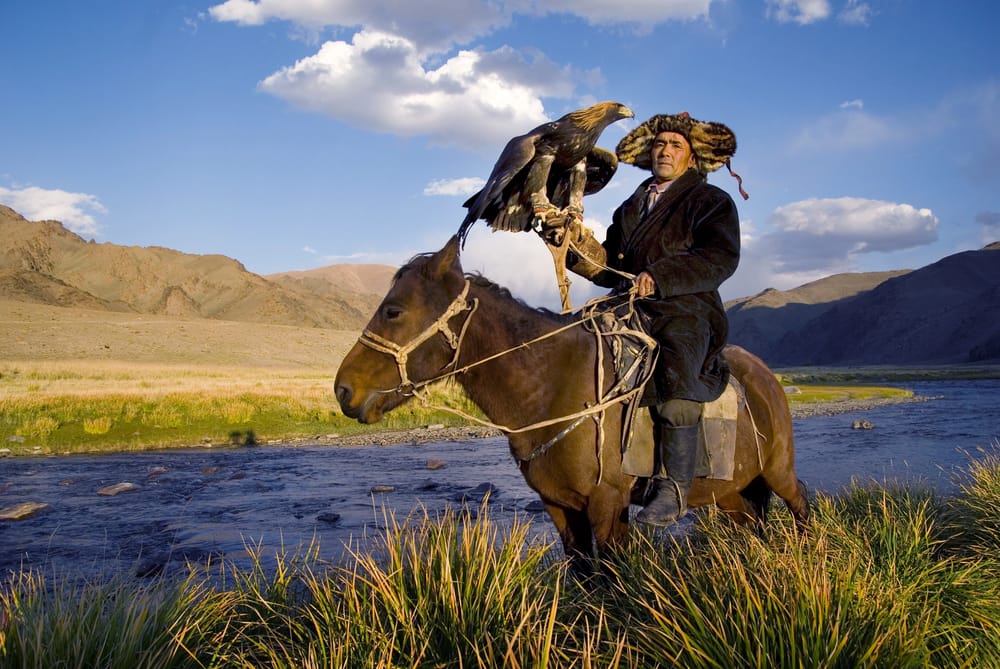
The Altai Mountains in the far west are for the ones who want to earn it. Trekking, dramatic terrain, and the eagle hunters whose traditions run generations deep. It takes effort to reach and pays you back in stories nobody at home will quite believe.
Terelj National Park is the easy win, close enough to Ulaanbaatar for a weekend, wild enough to feel like a proper escape. Ride horses, scramble over rock formations, and sleep in a ger without committing to a multi-day expedition. Consider it Mongolia on training wheels, in the best way.
The Orkhon Valley is the UNESCO-listed heart of nomadic Mongolia, a sweep of grassland, ancient monuments, and the Orkhon waterfall that has been home to herding cultures for thousands of years. It is quieter than the headline sights and somehow all the better for it. This is where you go to understand what the whole country is built on, and to sit by a river with nowhere you need to be.
Getting Around and Getting Set Up
Mongolia rewards travellers who stay flexible, because transport out here has its own logic. Domestic flights with MIAT and Hunnu Air connect Ulaanbaatar to provincial hubs like Ölgii, Mörön, and Dalanzadgad, and they save serious time in the west even if they cost more. The Trans-Mongolian Railway runs north to south and is a cheap, scenic way to cover distance, though summer tickets go fast, so book a few days ahead. Shared jeeps and vans handle the routes buses do not, but they leave when full rather than on any timetable, so pack your patience.
Landing admin is quick if you front-load it. Open a local account at one of the major banks such as Khan Bank, Golomt, or the Trade and Development Bank. Grab a SIM from Mobicom, Unitel, or Skytel for cheap local calls, and download offline maps before you head anywhere remote, because coverage disappears the moment the city does. Save photos of every official document to the cloud too, since Mongolia's paperwork still runs heavily on physical copies.
On accommodation, most travellers line up a room in Ulaanbaatar once they land, through local rental agencies, online listings, or word of mouth, rather than locking in a long lease from home. Out in the countryside the ger camps and family homestays are the accommodation and half the reason you came, so lean into them when you travel.
Sorting Your Cover
Comprehensive health insurance is a hard requirement for this visa, not a nice-to-have, and because there is no packaged trip covering it for you, this one sits on your plate to organise. That is where Global Travel Cover fits neatly. It is the travel and medical insurance brand in the Global Work & Travel family, built for exactly this kind of long, far-flung trip, with $0 deductible cover, the flexibility to buy and renew from anywhere, snow sports included as standard, and a 24/7 emergency line for when something goes sideways at 2am in a place where you do not speak the language. For a year built around remote regions and long distances, that safety net earns its place.
Final Thoughts
Here is the honest read. Mongolia is not the plug-and-play working holiday, and that is precisely the point. It asks more of you than the well-worn routes, and it hands back a year almost nobody else will ever have. Space that recalibrates you, a culture still living close to its roots, and the quiet flex of having done the one your whole feed skipped.
If you are Australian, aged 18 to 30, and even slightly the type who reads to the end of a Mongolia guide, this is your window, and it is a small one at 100 places a year. Get your documents clean, chase that consent letter early, and go be the friend who actually did it.
We also publish extensive working holiday visa guides for United States, Canada, Australia, United Kingdom, Germany, France, Spain, Italy, Ireland, Norway, Korea, Argentina, Chile, Hong Kong, Estonia, Netherlands, Austria, Slovakia, Portugal, Peru, Greece, Singapore, Malaysia, Taiwan, Mongolia, Indonesia, Vietnam, Thailand, New Zealand, Chile, Ecuador, Brazil, Israel, Czech
Republic, Mongolia, Papua New Guinea, and more coming.

Jessie Chambers
Jessie is a globetrotter and storyteller behind the Global Work & Travel blog, sharing tips, tales, and insights from cities to remote escapes, informed by the collective experience and real-world knowledge of teams across our business.